







Quick Summary
- Renewable energy is evolving from a sustainability initiative into a strategic financial decision for Indian businesses. The blog explores how
- CFOs can leverage clean energy finance, long-term power cost savings, accelerated depreciation benefits, flexible project financing structures, and emerging carbon markets by making the simple switch to RE
- Corporates who have maximised renewables adoption include improved financial resilience, optimized operational costs, and better long-term business competitiveness as benefits
1. The Buck Stops with the CFO
Picture a typical Monday morning leadership meeting. On one side of the table, the Chief Sustainability Officer highlights ambitious net-zero targets and carbon footprint reductions. On the other side, the Chief Operations Officer voices concerns over grid volatility and rising power costs.
As the CFO, the ultimate decision rests on your desk. For years, environmental, social, and governance (ESG) initiatives were viewed strictly as cost centres or public relations exercises. But a massive paradigm shift is underway across the business landscape. Today, balancing the green ledger isn’t just about corporate citizenship, it is about deploying smart capital, mitigating structural operational risks, and driving bottom-line profitability.
For modern financial leaders, transitioning to renewable energy has evolved from an environmental choice into a strategic long-term financial decision. Here is the operational road map, the metrics, and the fiscal incentives that every CFO needs to navigate this transition effectively.
2. The Macro Shift: Scaling Assets, Reducing Overhead
The financial case for clean energy begins with basic market economics: supply, demand, and utility overhead. Historically, relying entirely on regional utility grids exposed businesses to unpredictable tariff hikes and fuel surcharges. Clean energy generation completely alters this dynamic by transforming variable operational energy expenses into highly predictable, fixed capital infrastructure.
The scale of adoption underscores this shift. India’s Commercial and Industrial (C&I) renewable energy segment is expanding rapidly, with installed capacity projected to rise to approximately 57 GW by FY28, up from the 40 GW benchmark targeted at the end of FY26. This momentum has been heavily accelerated by frameworks like the Green Energy Open Access (GEOA) Rules, which allow high-consumption enterprises to bypass local utility monopolies and procure power directly from efficient, large-scale renewable developers.
By locking in long-term Power Purchase Agreements (PPAs) or investing in open-access setups, businesses are securing power tariffs that land 25% to 30% lower than conventional on-grid commercial tariffs. For energy-intensive industries—such as manufacturing, pharmaceuticals, and data centres— slashing electricity overhead by nearly a third provides a major structural advantage that reflects directly in expanded operating margins.
For many Indian industries, renewable energy is also becoming an energy security strategy. As grid volatility, peak power shortages, and tariff uncertainty increase, businesses are looking at renewable energy not only for sustainability and savings, but also for greater operational resilience.
3. De-Risking Capital: The Global Landscape of Clean Energy Finance
Deploying capital into alternative infrastructure requires a thorough understanding of asset classes and financing structures. Globally, institutional capital is increasingly moving toward decarbonization. In recent fiscal cycles, global energy investments reached approximately $2.8 tn annually, with over $1.7 tn flowing directly into clean technologies.
This massive influx of capital has fundamentally altered the risk profile of clean energy finance. Over the past decade, renewable energy asset portfolios have consistently outperformed many legacy fossil-fuel investments in long-term yield stability, providing a strong hedge against geopolitical oil and gas market volatility.
For business treasuries, this means liquidity pools, specialized green bonds, and tailored commercial credit lines are becoming more accessible than ever. Whether choosing a CapEx model (direct ownership) or an OpEx model (thirdparty developer owned), the deep liquidity in green financial markets ensures competitive borrowing rates and flexible financing structures.
Increasingly, investors, global customers, and financial institutions are evaluating companies based on their long-term sustainability and decarbonization strategies, making renewable energy adoption an important
part of long-term business positioning.
4. Structuring the Deal: Off-Balance-Sheet Project Financing
When a CFO decides to move forward with a large-scale renewable rollout, the immediate next question is structural:
“How do we fund this without locking up our primary credit lines or over-leveraging our core balance sheet?”
This is where sophisticated project finance frameworks become invaluable. For large-scale solar, wind, or hybrid installations, many enterprises set up a distinct Project Company or Special Purpose Vehicle (SPV). This isolates the financial risk directly to the energy asset itself.
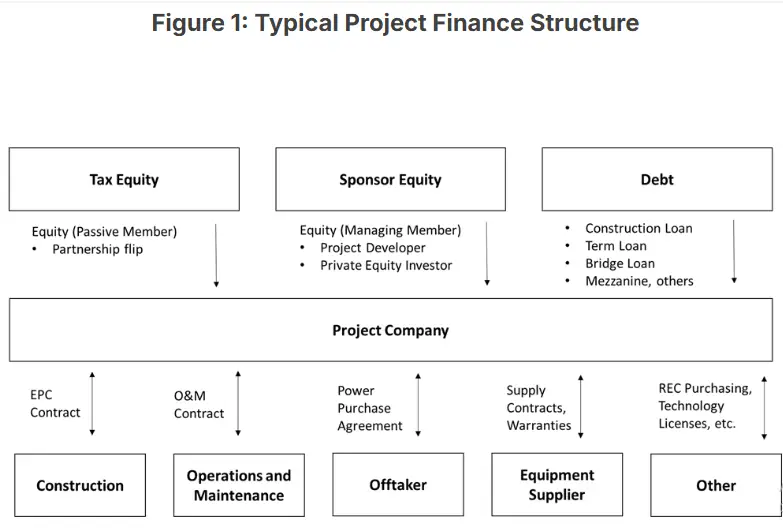
In this framework, the business acts as the Offtaker, signing a long-term Power Purchase Agreement (PPA) with the Project Company. Meanwhile, capital is pooled from multiple specialized sources:
- Sponsor/Developer Equity for execution capital
- Debt financing secured by future project cash flows
- Tax equity or passive investors supporting incentive monetization
This ring-fenced structure ensures that the project remains non-recourse or limited-recourse to the parent organization, helping protect the balance sheet while securing predictable long-term energy costs.
5. Maximizing the Fiscal Cushion: Tax Depreciation Benefits
When evaluating the internal rate of return (IRR) on an onsite solar plant or wind asset, the tax depreciation timeline plays an extraordinary role in shortening the payback period. Governments utilize aggressive tax policy levers to minimize the upfront financial friction of these installations.
Under Section 32 of the Indian Income-tax Act, enterprises can leverage powerful renewable energy asset depreciation tax benefits. Specifically, qualified solar power projects are eligible for an Accelerated Depreciation (AD) rate of 40% year-on-year on a written-down value (WDV) basis.
By writing off 40% of the asset cost in the first year, businesses can significantly reduce taxable income, shielding vital cash flow during the early stages of capital expenditure.
For many Indian businesses, these depreciation benefits play a major role in improving project viability and shortening investment recovery timelines. Combined with long-term operational savings, renewable energy projects can often achieve payback within 4 to 7 years while continuing to deliver cost benefits for over two decades.
6. Monetizing Sustainability: Carbon Credit Investment Strategies
Beyond immediate power cost reductions and upfront tax write-offs, renewable infrastructure introduces a secondary corporate revenue stream: environmental asset markets.
Following key legislative updates—such as the amended Energy Conservation Act and the rollout of the Carbon Credit Trading Scheme (CCTS)—a formalized national framework has emerged. Under this ecosystem, designated government agencies issue Carbon Credit Certificates (CCCs), where exactly one certificate represents the verified reduction or removal of one tonne of carbon dioxide equivalent (1 tCO2e) from the atmosphere.
For forward-looking financial leaders, creating a carbon credit investment strategy for enterprises delivers a two-fold advantage:
- Compliance Cost Avoidance: Obligated enterprises that exceed their greenhouse gas (GHG) emission targets can surrender self-generated certificates and avoid non-compliance penalties.
- Direct Revenue Generation: Organizations with surplus certificates may monetize them through emerging carbon trading ecosystems. Industry estimates project the domestic carbon credit market could scale past $10 billion by 2030, driven by strong annual growth throughout the decade.
By integrating carbon asset management into treasury operations, CFOs can effectively transform verified carbon reduction metrics into tradable financial assets.
7. The Bottom-Line Conclusion
For the modern CFO, evaluating renewable energy investments is no longer about checking an ethical box or satisfying a sustainability committee. It is a comprehensive strategy to manage operational risk, optimize tax liabilities, and generate predictable long-term returns.
By locking in long-term power costs 25% to 30% below current grid prices, utilizing a 40% accelerated depreciation tax shield, applying flexible financing structures, and tapping into a rapidly growing carbon market, renewable energy investments are proving their value directly on the balance sheet.
The financial tools, capital liquidity, and regulatory incentives are already in place. The only remaining question for financial leaders is how quickly they will move to capture these long-term advantages.
As India accelerates toward a cleaner and more competitive industrial future, renewable energy will increasingly become a defining component of long-term business strategy.