






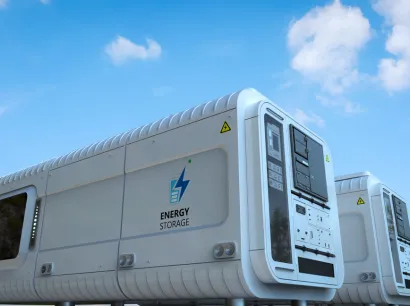
Battery Energy Storage Systems (BESS) are becoming an important part of India’s renewable energy transition. As solar and wind capacity grows, the challenge is no longer only to generate clean electricity, but to make it available when the businesses need it.
BESS addresses this challenge by storing electricity when it is available and discharging it later. When paired with renewable energy generation, it can shift clean energy from periods of high generation to periods of higher demand, support grid flexibility and help businesses achieve round-the-clock renewable energy.
Key takeaways
· As of June 2026, India had 2.93 GW / 8.66 GWh of installed Battery Energy Storage System (BESS) capacity.
· India’s installed energy storage capacity to hit 346 GWh by 2033.
· BESS can support renewable energy integration, peak-demand management, backup, power-quality support and other grid services.
· Government measures include Energy Storage Obligations, VGF support and transmission-charge waivers for eligible projects.
· For C&I businesses, the right BESS solution depends on load profile, RE generation, required backup, operating strategy, grid connection and system design.
What is a Battery Energy Storage System (BESS)?
A BESS stores electrical energy in battery cells and makes it available when required. A typical system combines battery modules with a battery management system (BMS), power conversion system (PCS), energy management controls, safety systems, etc.
During charging, electricity is converted and stored electrochemically in the battery. During discharge, the stored energy is converted back into electricity and supplied to the load or grid.
Two measurements are particularly important:
· Power, measured in kW or MW, indicates how quickly the system can charge or discharge.
· Energy, measured in kWh or MWh, indicates how much electricity the system can store.
Lithium-ion technology is widely used in today’s grid-scale BESS because of its energy density, response capability. Other technologies, including sodium-ion, are also emerging as India looks to diversify storage technologies and supply chains.
Why is BESS becoming important in India?
India is adding RE capacity at scale, while electricity demand continues to evolve. Solar generation is concentrated during daylight hours, whereas demand can remain high later in the day. Wind generation can also vary with weather conditions.
This creates a flexibility requirement: the power system needs resources that can respond when renewable energy generation and demand do not align.
· Shifting renewable energy from high-generation periods to later demand periods;
· Supporting peak-demand management;
· Providing fast-response grid services;
· Improving power reliability for suitable C&I applications;
· Enabling higher utilisation of renewable electricity in round-the-clock supply structures.
For businesses, this means BESS is not simply a backup battery. Depending on how it is designed and operated, it can become an active part of the company’s energy-management strategy.
India's BESS landscape: where does the market stand?
India’s BESS market has moved from early demonstrations towards large-scale procurement and deployment.
As of 30 June 2026, India had 8,660.20 MWh of installed BESS capacity for systems above 1 MWh. The development pipeline is considerably larger: 42,530 MWh was under construction, 38,425 MWh had been awarded, and 67,574 MWh was at the tendering stage.
This pipeline shows that the market is expanding beyond individual projects towards a broader storage ecosystem involving utilities, RE developers, system integrators, technology providers and C&I energy users.
The CEEW-GFC Market Handbook identified FY26 as an important year for storage, with 37 storage tenders announced, including 31 for BESS. This indicates growing demand for storage as renewable penetration increases.
Who is building BESS in India?
The Indian BESS ecosystem includes utilities and power-sector entities procuring storage, RE developers integrating storage with generation, system integrators designing and commissioning BESS, battery and power-electronics manufacturers, and software providers supporting energy management and optimisation. For C&I customers, this increasingly means evaluating an integrated solution rather than
selecting a battery in isolation. The choice of energy partner can be equally critical, particularly when the solution needs to integrate clean energy generation, storage, grid power and the customer’s operational requirements.
What is driving BESS adoption in India?
1. Renewable energy integration
BESS can absorb surplus RE generation and discharge it when renewable output is lower or demand is higher.
2. Round-the-clock renewable power
Solar and wind can be combined with storage to create more predictable renewable energy supply. BESS can help bridge the gap between renewable generation and a business’s consumption profile.
3. Peak-demand management
A correctly sized BESS can discharge during selected high-demand periods, reducing the amount of power drawn from the grid during those periods.
4. Reliability and backup For facilities where continuity of operations is critical, BESS can provide backup power and help maintain essential operations during grid interruptions, when configured for that purpose.
5. Decarbonisation
By increasing the share of renewable electricity that can be used when needed, storage can support corporate decarbonisation and Net Zero strategies.
Government policy for BESS in India
India has introduced a range of policy and regulatory measures to support the deployment of energy storage.
BESS deployment and procurement: The Government has established a framework for BESS procurement, including competitive bidding and participation in electricity markets.
Viability Gap Funding: The Government has approved VGF schemes supporting BESS deployment, including a 30 GWh scheme backed by ₹5,400 crore from the Power System Development Fund.
Transmission-charge support: Eligible co-located BESS projects commissioned by June 2028 can receive a 100% waiver of ISTS charges, subject to applicable conditions.
These measures, together with competitive procurement and increasing storage requirements, are helping build the market for BESS in India.
How BESS works with Open Access renewable energy
For C&I businesses procuring renewable energy through Open Access, BESS can add flexibility to the renewable energy supply profile.
A solar or wind project generates electricity according to resource availability. A battery can store part of that electricity and discharge it later based on the agreed operating strategy. This can help businesses:
· Increase the usable share of renewable energy;
· Align renewable energy supply more closely with their load profile;
· Manage selected peak-demand periods;
· Improve energy resilience; and
· Support a pathway towards round-the-clock renewable energy.
The right configuration depends on the facility’s hourly load curve, renewable energy generation profile, grid connection, required duration, operating strategy and applicable state and market regulations.
Rooftop Solar Plant for HUL
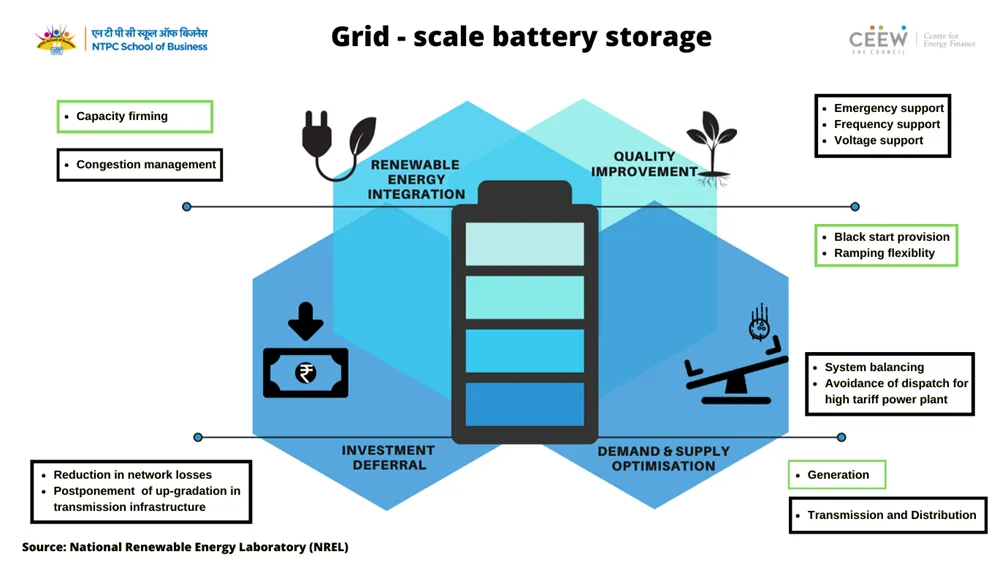
Infographic Source: CEEW
AI-enabled BESS
BESS performance is increasingly linked to software and energy-management systems.
AI and advanced analytics can use inputs such as weather forecasts, renewable generation, electricity demand and battery operating data to improve charging and discharging decisions. Predictive analytics can also help identify abnormal operating conditions and support maintenance planning.
The value of AI is therefore not simply automation. It is the ability to coordinate storage with the wider energy system and use the battery more intelligently while respecting technical and safety constraints
AI-enabled BESS: from storage asset to intelligent energy system
A BESS should be sized around the business problem, not simply around the desired battery capacity. The questions a C&I company looking to deploy BESS should ask are:
· What is the facility’s hourly load profile?
· How much renewable electricity is already available or planned?
· How much energy needs to be stored?
· How long should the battery discharge for the intended use case?
· What grid and regulatory requirements apply to the site?
· How will the system be monitored, operated and maintained over its lifecycle?
The future of BESS in India
BESS is becoming an important flexibility layer for India’s power system. The combination of growing renewable generation, rising electricity demand, storage obligations, government support and large procurement pipelines is accelerating the development of the sector.
For C&I businesses, the opportunity goes beyond backup power. A well-designed BESS can help integrate more renewable electricity, manage demand, improve resilience and support the transition towards round-the-clock clean power.
As India’s storage market matures, the focus will increasingly shift from simply installing batteries to designing, operating and integrating storage assets that deliver measurable value across the energy system.
Fourth Partner Energy’s Battery Energy Storage Systems footprint
Fourth Partner Energy has been an early mover in BESS deployment across multiple States and industrial sectors. We have an in-house vertical dedicated to deploying BESS solutions, in addition to our RE solutions to help corporates maximise their clean energy adoption, as well as savings.
Our installed BESS portfolio is over 60 MWh, powering clean energy reliability for 30+ corporate clients, including marquee names such as Flipkart, Metro Cash and Carry, and NTPC NETRA.
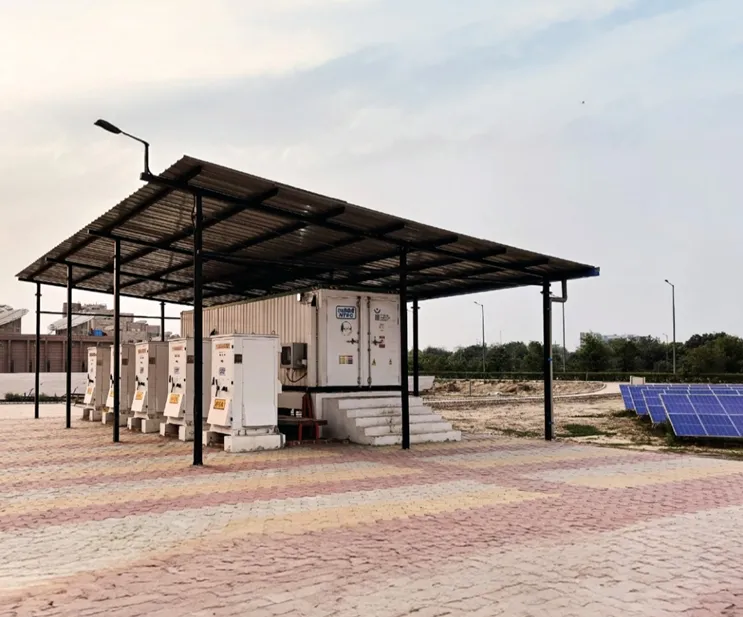
Fourth Partner Energy’s 4 MWp Solar + 1 MWhr BESS installation at NTPC NETRA, Noida
FPEL’s goal is to deliver dependable storage-backed energy solutions that reduce peak charges, improve power quality and make clean power more productive for Indian industries.
Ready for Round-the-Clock green power?
Talk to us about deploying BESS for your business operations by writing to marketing@fourthpartner.co
FAQs
Is BESS safe for industrial deployment?
Yes. Modern BESS comes with multiple safety layers including battery management systems, cooling, fire protection and remote monitoring to ensure safe operation.
How does BESS enable RTC power?
Solar is daytime-heavy. BESS stores this surplus energy and supplies it later, making clean power steady, predictable and round-the-clock.
Does BESS help in reducing cost?
Yes. By shifting consumption away from peak tariff hours and also by reducing dependency on grid, BESS brings down the final cost per unit of electricity.
How fast is BESS adoption in India?
Very fast. As industries commit to Net Zero targets and 24×7 clean power, battery energy storage system India adoption is accelerating rapidly and becoming a core part of industrial energy strategy.
Where do we see highest demand for BESS?
Data centres, manufacturing clusters and large commercial campuses where reliability, backup and RTC clean power supply are critical.