



Executive Summary
- Fourth Partner Energy has introduced PentaGuard™, a promise that defines how safely every rooftop solar plant we deliver is designed, built and maintained.
- This blog explains the five tenets behind the promise, electrical, fire, structural, operational and digital safety, and what each one means for the business under the roof.
- It also sets out how we arrived at these five, and why safety deserves a place alongside cost and savings when comparing proposals.
Introduction
For a business evaluating rooftop solar, the first questions are often straightforward: “How much will it cost?” and “How much will we save?”
These are the right questions to start with. They are not the only ones.
A rooftop solar plant is not installed and forgotten. It runs on a working building for around 25 years, above the people, machines and stock the building exists to protect, and it is visited regularly for cleaning and maintenance.
That raises a question proposals rarely answer in detail: how safely will the plant be built and run over that time?
PentaGuard™ is our answer. This blog explains what it is, the five tenets it rests on and why we chose them.
What is the PentaGuard™ Promise?
PentaGuard™ is Fourth Partner Energy’s safety framework for rooftop solar. It sets out, in specific and verifiable terms, how every plant we deliver is designed, built and maintained to protect the business underneath it.
Rather than describing safety in general terms, each PentaGuard™ measure is listed in the proposal and supported by records once the plant is running.
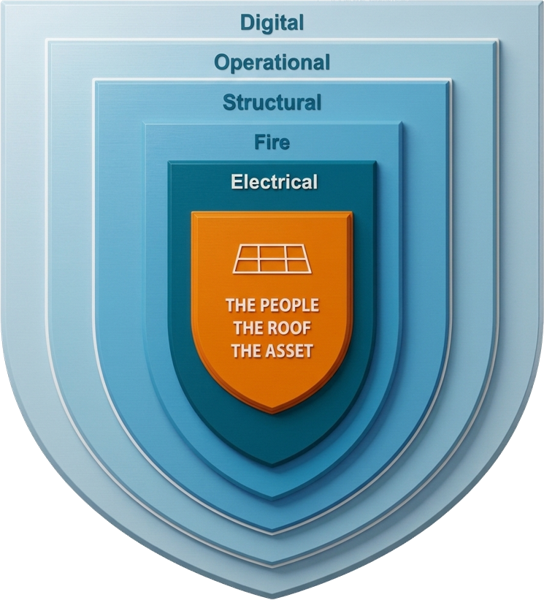
PentaGuard™: Five layers of protection, with the business at the centre
The Five Tenets of PentaGuard™
Think of PentaGuard™ as five promises. Each one answers a question that any business hosting a rooftop solar plant should be able to ask, and together they cover how power flows, how fire is prevented, how the roof is treated, how the plant is looked after and how it is accessed online.
| Tenet | The question it answers | Our promise |
|---|---|---|
| 1. Electrical | What happens when something goes wrong electrically? | Every fault has a safe way out. |
| 2. Fire | Could the plant ever start a fire? | Small faults are caught before they grow. |
| 3. Structural | Is my roof safe with a plant on it? | Your roof stays sound, dry and safe to walk on. |
| 4. Operational | Who is working on my roof, and how? | The trained people, working the right way, on every visit. |
| 5. Digital | Who can see or control my plant online? | Only authorized people have the access. |
1. Electrical Safety
Every building already relies on earthing and circuit breakers to stop an electrical fault from turning into a shock or a fire. A solar plant needs the same protection on a larger scale. It produces power all day, stands exposed to lightning and connects to your electrical system and DG set.
Under PentaGuard™, every plant is earthed to IS 3043, and each earth pit is tested, with the readings handed over to you. A lightning arrester to IEC 62305 sits on its own earth pit, surge protection is built into the inverter, and zero-export control with a DG interlock stops solar power from flowing back into your generator during a power cut.
For you, that means protected equipment, a DG that switches over smoothly and earthing that works.
2. Fire Safety
At home, most electrical fires start at a loose plug or an overloaded socket, not inside the appliance itself. Solar plants are similar. When something goes wrong, it usually begins at a single joint or a poorly routed cable.
PentaGuard™ uses one make of connector throughout the plant, so every joint fits exactly as it was designed to. Positive and negative DC cables run in separate trays and never share a path. Periodic thermal scans pick up a warm joint long before it is visible to the eye, and the right extinguishers are kept on site.
For you, that means small faults are found and fixed while they are still harmless.
3. Structural Safety
No one would add a floor to a building without first checking that the structure can carry it. A rooftop solar plant deserves the same care, because it adds weight and regular foot traffic to a roof that was built to shelter what lies beneath it.
Before installation, every roof goes through a leakage test, a structural stability report and a load and tilt assessment. Mounting is non-penetrative, so the roof sheets are never drilled. SS316 lifelines, edge guardrails and mesh over skylights then make the roof safe for anyone who works on it.
For you, that means a roof that stays sound and dry, and safe to walk on for the life of the plant.
4. Operational Safety
Airlines run the same checks before every flight, however many times an aircraft has flown. Looking after a solar plant calls for the same discipline, and every such visit puts people on your roof, close to live equipment.
PentaGuard™ plants are maintained by our in-house team, certified for work at height, medically screened and inducted on your site. Every task runs on a permit-to-work with lockout and tagout, every shift begins with a documented safety briefing, and a dedicated safety officer is on site during commissioning.
For you, that means knowing who is on your roof, what they are trained to do and that every job follows your site rules.
5. Digital Safety
You would not protect your bank account with a password alone. A solar plant that is monitored, and in many cases controlled, online deserves the same care.
Every login to the plant platform needs a one-time code, and each person sees only the plants they are responsible for. The platform is hardened against the OWASP Top 10 and independently tested, and Fourth Partner Energy is ISO 27001:2022 certified.
For you, that means your plant’s data and controls stay in the right hands.
How We Arrived at These Five
We did not begin with a list of equipment. We began with the building, and asked one question: in how many ways can a rooftop solar plant affect the business underneath it?
The answer came down to five areas: how power flows, how fire is prevented, how the roof is treated, how the plant is maintained and how it is accessed online. Leaving any one of them open means the risk stays on your premise.
That led us to a simple principle:
A rooftop solar plant is only as safe as its weakest layer.
Same Capacity, Different Plants
Imagine two businesses comparing rooftop solar proposals for plants of identical size.
The first proposal lists capacity, equipment brands and expected savings.
The second lists the same, along with exactly how faults, fire, falls, maintenance and online access will be handled.
On paper, both offer the same capacity. In practice, they are offering different plants.
The question, therefore, should not be “Which proposal is cheaper?” but “Which proposal gives me the peace of mind?”
Management Speak
As Jay Kumar Waghela, CEO, Distributed Business Unit, Fourth Partner Energy, explains:
“A rooftop solar plant shares a building with people and operations for decades, so its safety cannot be left to chance. With PentaGuard™, we have defined what safety means across five layers and built it into every plant we deliver. Our customers know exactly what they are getting, and can be confident that the plant on their roof has been designed to protect their business.”
Conclusion
So, what does the PentaGuard™ Promise stand for?
A rooftop solar plant whose safety is defined before it is built, and kept up for as long as it runs.
For businesses evaluating rooftop solar, the most useful step is to look beyond capacity and tariff, and to ask each developer how their plant will be protected.
A well-evaluated proposal should answer three questions:
How will the plant handle a fault, a surge or a fire?
How will the roof, and everyone working on it, be protected?
How will the plant be maintained and accessed over its life?
That is the foundation for a solar decision that is both sound and safe.
FAQs
1. What if other developers/EPC contractors can offer the same safety measures?
Individual safety measures can be specified by any developer. What sets PentaGuard™ apart is our experience behind it. Over 15 years and more than 2,000 projects, Fourth Partner Energy has seen what keeps rooftop plants safe in practice, across different roofs, climates and years of operation. PentaGuard™ brings that experience together into one defined framework, built into every plant and maintained by the same team that builds it, so safety never depends on who happens to be on site that day.
2. How will I know the PentaGuard™ measures are in place?
Each measure is listed in your proposal. Once the plant is running, you receive supporting records, such as earthing test results, the roof assessment and maintenance logs.
3. Can PentaGuard™ be tailored to my site?
Yes. The final specification depends on a site assessment covering the roof type, the use of the building and the level of risk. Our team recommends a plan once the assessment is complete.
Planning a rooftop solar plant? Talk to Fourth Partner Energy about building it with PentaGuard™. Write to us today: marketing@fourthpartner.co