






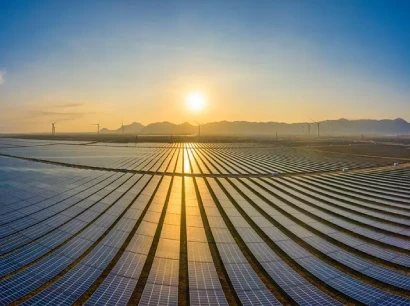
What is a Ground-Mounted Solar System?
Ground-mounted solar refers to a solar panel system that is fixed directly to the ground instead of being placed on a roof. This setup usually uses strong racks connected to piles driven into the ground or mounted on concrete footings. This design allows panels to be set at the best angle to capture the sunlight year-round, which boosts overall energy production.
About 60% of global solar installed capacity comes from ground-mounted solar farms, highlighting its widespread adoption. In India specifically, there is enormous potential for ground-mounted solar: the National Institute of Solar Energy (NISE) reports that India could deploy about 3,343 GWp of ground-mounted solar PV across 27,571 square km of wasteland.
Unlike rooftop solar, ground-mounted systems can be expanded to meet higher energy needs. This makes them suitable for commercial, or even utility-scale solar projects. Another advantage is that they don’t need a roof structural assessment, which can simplify the installation process.
Ground-mounted solar is a key contributor in India’s clean energy revolution and contributes almost 75% of total solar power capacity of 162.15 GW, with 121.25 GW being generated via utility-scale ground-mounted installations by May 2026. During FY2025–26, almost 34.8 GW of capacity was added. As India aims to generate 500 GW of non-fossil fuel capacity by 2030, the ground-mounted solar industry is set to remain the cornerstone of India’s renewable energy strategy.
How Ground-Mounted Solar Systems Work?
A ground-mounted solar installation works like any other solar PV system. Solar cells in the panels convert sunlight into direct current (DC) electricity, which is then sent through wiring to one or more inverters. The inverter changes DC power into alternating current (AC), the type of electricity used in businesses.
Any extra energy produced by the system can be sent back to the grid through net metering, effectively turning your meter backward and earning you credit on your electricity bill.
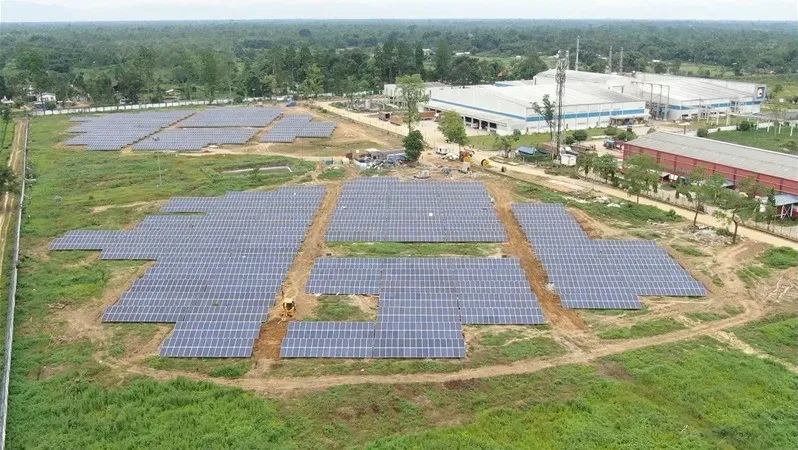
Ground Mounted Solar Plant for HUL
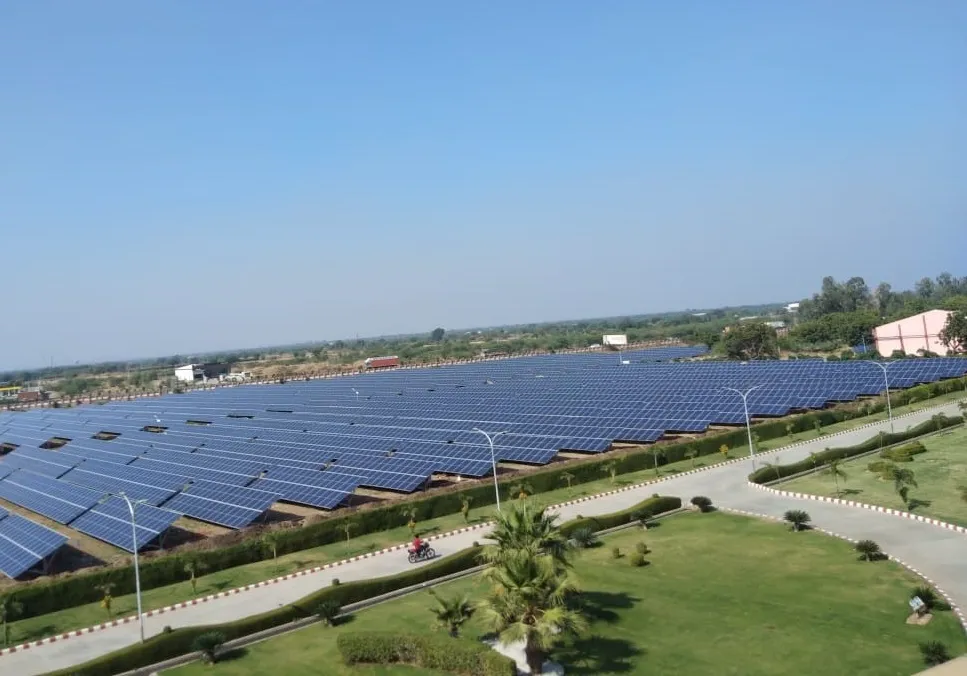
Ground Mounted Solar Plant for RSWM
Types of Ground-Mounted Solar Systems
Ground-Mounted Solar Systems are not all the same. The way you mount the panels has a big effect on how much energy you get how much land you use and how much it costs to take care of the system over time. So choosing the mounting structure is a very important decision when you are designing a project.
The common type of Ground-Mounted Solar System is the fixed-tilt system. This is also the option. The solar panels are put up at an angle that is decided beforehand between 20° and 28° in India depending on where you are in the country. The panels do not move to follow the sun they just stay in one place all year. Even though they do not track the sun, fixed-tilt systems are simple. Do not need a lot of maintenance. They also give you energy that you can count on. For commercial and industrial projects in India fixed-tilt systems are the standard choice.
Single-axis tracking systems are another type of Ground-Mounted Solar System. These systems move the panels from east to west as the sun moves across the sky. This helps to make energy, up to 25% more than a fixed-tilt system. You do not have to pay a lot more for this type of system. Single-axis tracking systems are becoming more popular for commercial and industrial projects in India especially in places like Rajasthan, Gujarat and Andhra Pradesh where the sun shines a lot.
Dual-axis tracking systems are also a type of Ground-Mounted Solar System. These systems follow the sun as it moves across the sky and also as it changes position in the sky throughout the year. This helps to make the most energy possible up to 40% than a fixed-tilt system.. These systems are also more complicated and need more maintenance. That is why you do not see them used often for big commercial projects. They are often used for special types of solar power systems or for research.
Pole-mounted systems are another type of Ground-Mounted Solar System. These systems use one pole to hold up a few panels. They are often used for projects like phone towers or water pumps, where you need to save space. For commercial projects pole-mounted systems are not usually used as the main type of system.. They might be used as part of a bigger system. Ground-Mounted Solar Systems like these are good, for different types of projects.
Advantages of Ground-Mounted Solar
There are several benefits to ground-mounted solar that make it appealing for many businesses:
- Optimal orientation and tilt control: Panels can be positioned perfectly to maximize energy production.
- Improved cooling and airflow: Better ventilation keeps panels cooler, which can slightly enhance efficiency.
- Easy maintenance and access: No need to climb on rooftops for cleaning or repairs.
- Scalability: Ideal for larger installations where rooftop space is limited.
Key Factors to Consider Before Installing
Before starting your ground-mounted solar installation, it is essential to consider several factors to ensure optimal performance and cost-effectiveness.
Site & Land Conditions:
The size, shape, and slope of your land directly influence how many panels can be installed and how efficiently they will operate. Flat or gently sloped land with minimal shading is ideal. Soil type is also important; rocky or loose soil might require extra foundation work, which can raise costs.
Climate & Solar Resource:
Understand your region’s solar irradiance and seasonal sunlight patterns to accurately estimate energy production. Extreme weather conditions, such as high winds, heavy rain, or snow, should be considered in system design. Dusty or coastal areas may need additional anti-corrosion protection and regular cleaning.
Orientation & Tilt:
Panels should face true south (in the northern hemisphere) and be tilted according to your latitude for maximum efficiency. If you choose a tracking system, you can further increase energy yield but be prepared for higher installation and maintenance costs.
Regulatory & Financial Considerations:
Check local zoning laws, permits, and interconnection policies. Larger projects may need environmental assessments. Financially, consider the total system cost, including panels, mounting, wiring, installation, and ongoing maintenance. Look into solar incentives, subsidies, tax credits, and net metering options to reduce your payback period and improve ROI.
FAQs
How is ground mounted solar different from rooftop solar?
A ground mounted solar is installed on the ground using racks or mounting structures, rather than on a roof. It allows panels to be placed at the optimal tilt and orientation for maximum sunlight exposure, which can improve energy production. Unlike rooftop solar, it doesn’t depend on roof space or condition, making it ideal for larger systems or properties with limited roof area.
What are the main advantages of ground mounted solar?
The key advantages of ground mounted solar include higher efficiency due to optimal tilting, better cooling and airflow around the panels, easy access for cleaning and maintenance, and scalability for larger energy needs. These systems are also flexible in placement, as they can be installed anywhere on your property with good sunlight exposure.
How much land do I need for a ground mounted solar system?
On average, a 1 kW ground mounted solar installation requires around 100–120 square feet of space, though this can vary based on panel type, row spacing, and shading considerations. Larger commercial or utility-scale projects will need detailed site surveys to optimize space utilization and energy yield.
Is a ground mounted solar installation more expensive than rooftop solar?
Yes, generally ground mounted systems have slightly higher upfront costs due to the need for additional materials like mounting racks, foundations, and more extensive wiring. However, the improved performance, easier maintenance, and potential for larger installations often balance out the extra investment over time.
Do I need special permits for ground mounted solar?
In most regions, you will need local zoning approval and installation permits for a ground mounted solar system. For larger systems, you may also need environmental clearances or grid interconnection agreements. Working with a certified solar installer helps ensure compliance with local regulations and avoids project delays.
Ready to Explore Ground-Mounted Solar for Your industry?
Take the first step toward clean, reliable energy. Email us at marketing@fourthpartner.co and our team will help you with a site assessment and a customized solar proposal.