






As companies seek to cut emissions and boost energy efficiency, one question often arises: How can we support electric transportation and create sustainable energy without needing new construction or extra land?
The answer might surprise you; it’s right in your parking lot. Regular parking lots are turning into smart energy hubs thanks to solar carports. These structures can charge electric cars while generating renewable electricity and providing shade.
They are becoming the perfect blend of innovation, sustainability, and practicality for modern workplaces, factories, and campuses.
What Is a Solar Carport?
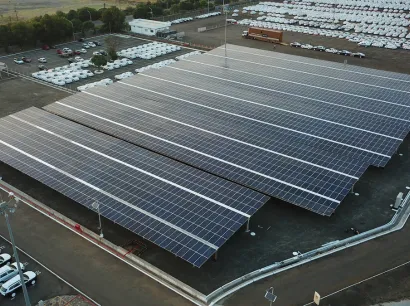
Think of a solar carport as a covered parking area with a small solar power plant on the roof. These elevated steel structures protect cars from heat, dust, and rain while housing solar panels that convert sunlight into electricity.
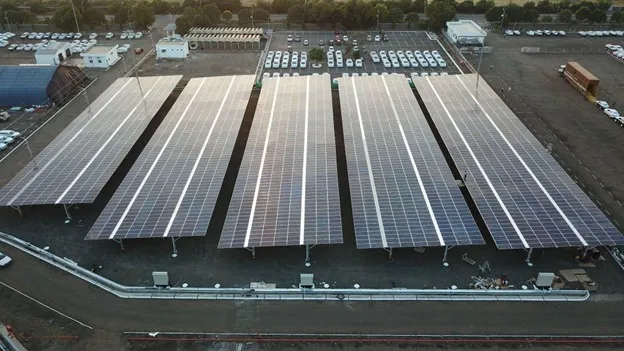
Solar carport solution for Skoda India, with capacity of 1150 KWp
Clean Energy + Increased Savings on per unit Electricity
Solar carports are highly efficient. The National Institute of Solar Energy estimates that each 1 kWp solar panel installed in India can produce 1,400 to 1,600 units of electricity per year. FPEL has successfully commissioned a 1,150 kWp solar carport plant for Skoda India that helps avoid 1,580 tons of CO₂ emissions annually and conserves over 3.7 million liters of water every year — contributing to a cleaner and more sustainable future.
By transforming asphalt into a high-value energy asset, solar carports address the twin challenges of urban land constraints and energy transition, making them the defining infrastructure of the modern, sustainable Indian campus.

Solar carport solution for GVMC
The Next Wave: Solar Carports + Fast Chargers + BESS
India’s journey toward Electric Vehicles (EVs) is accelerating. According to NITI Aayog, the country could see over 10 million EVs sold each year by 2030. As more employees and fleet vehicles shift to electric, reliable, and convenient charging infrastructure will become just as crucial as parking itself.
Solar carports aid this transition in becoming seamless and truly sustainable. By integrating Level 2 or DC fast chargers directly into the structure and adding optional battery energy storage systems (BESS), businesses create a complete, future-proof energy ecosystem right in their parking lot.

Solar carport solution for GVMC
Sustainability that YOU Can See – How can Solar Carports benefit your Business?
An often-overlooked benefit of solar carports is their visibility. They can stand at the forefront of your office – where employees, clients, and partners can see them daily. This makes Carports more than just an energy system; they symbolize your firm’s commitment to sustainability.
Installing a solar carport allows your business to:
- Strengthening ESG and Net Zero commitments.
- Earn LEED, IGBC, or GRIHA green building credits.
- Contribute directly to India’s 2070 Net Zero goals.
- Integrate clean energy into your company’s identity — visible, impactful, and inspiring.
Across India, FPEL is executing such installations, transforming corporate campuses, industrial zones, and educational institutions – by turning empty lots into symbols of progress and innovation. Write to us to find out how we can customize a similar requirement for your business.
Take the first step toward clean, reliable energy. Email us at marketing@fourthpartner.co, and our team will assist you with a site assessment and a customized solar proposal.
Frequently Asked Questions
What is the main difference between a solar carport and a regular rooftop solar installation?
The main difference is the location and structure. Rooftop solar is mounted directly on a building’s roof, using that surface area. A solar carport is a raised, free-standing steel structure built over a parking lot. It is specially made to generate clean electricity while providing shade and protection for vehicles. Carports often offer a better angle for capturing sunlight and seamlessly include EV charging infrastructure.
How do solar carports help companies meet their Net Zero and ESG goals without acquiring new land?
Solar carports provide an effective solution for corporate sustainability by using non-productive space. Instead of needing new land for a ground-mounted solar farm, they repurpose existing parking lot areas. This visible generation of renewable energy and the support for green EV charging significantly lowers a company’s carbon footprint. It provides tangible evidence that supports ESG (Environmental, Social, and Governance) reporting and Net Zero commitments.
What is the typical Return on Investment (ROI) or payback period for a commercial solar carport project?
The ROI varies based on system size, local electricity rates, and financing. However, many commercial solar carport systems have a payback period of 5 to 7 years through savings on electricity bills, combined with significant tax benefits like accelerated depreciation in India. Additionally, using a Power Purchase Agreement (PPA) model allows companies to achieve immediate savings with no upfront capital investment.
Can a solar carport power the entire campus, or is it just for EV charging?
A solar carport is designed to contribute to the overall energy needs of a facility. The electricity generated typically feeds directly into the company’s main electrical grid, offsetting part of the total consumption of the workplace, factory, or campus. While these structures are great for incorporating EV charging stations, the majority of the power produced is used to run operations, lights, and air conditioning throughout the entire site.